Growing companies rarely struggle because they lack people. More often, they struggle because the people they hire lack operational context.
As businesses scale, workflows become more complex, communication becomes more fragmented, and daily operations require greater coordination between departments, systems, clients, and internal teams. In that environment, hiring general support without industry familiarity often creates more friction instead of reducing it.
That is why many companies are shifting away from generic staffing approaches and prioritizing industry-specific operational support models instead.
Why Generic Staffing Often Creates Operational Friction
Traditional staffing models usually focus on filling positions quickly. While that may solve an immediate hiring need, it does not always solve the operational challenges behind it.
A candidate may have administrative experience, customer service skills, or general remote work experience — but still struggle to understand the pace, terminology, and operational structure of a specific industry.
This becomes especially noticeable in fast-moving environments where teams rely heavily on coordination, process consistency, and rapid communication. Operational friction becomes even more visible as companies scale.
In many cases, companies end up spending significant time retraining hires, correcting mistakes, or creating additional oversight layers that slow operations even further.
Why Industry Context Matters More Than Ever
Every industry operates differently. The workflows inside a roofing company are completely different from those inside a healthcare organization. Communication standards, scheduling processes, documentation requirements, client expectations, and operational priorities vary significantly from one vertical to another.
As remote and hybrid teams become more common, businesses increasingly need support professionals who already understand the operational environment they are entering.
Many growing companies are now prioritizing industry-focused operational support models instead of relying on generic staffing approaches.
Instead of simply outsourcing isolated tasks, companies are building specialized support structures that integrate directly into their daily operations. This shift is changing how modern staffing works.
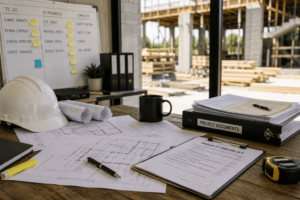
Construction Companies Need Teams That Understand Operational Complexity
Construction companies operate under constant movement and coordination. Estimating, scheduling, customer communication, project updates, production timelines, permits, invoicing, and subcontractor management often happen simultaneously across multiple projects.
In that environment, operational support teams need more than generic administrative skills. They need familiarity with how construction businesses actually function.
Construction companies often require operational support that already understands how projects move beyond the job site.
Roles like project coordinators, estimators, customer service representatives, and office managers directly impact operational efficiency when teams begin scaling.
Back office coordination becomes critical as roofing and construction companies grow.
Without operational alignment, even highly skilled companies can experience delays, communication breakdowns, and internal bottlenecks.
Healthcare Teams Require Specialized Administrative Support
Healthcare organizations face a different type of operational pressure. Patient communication, appointment scheduling, documentation management, administrative follow-up, and internal coordination all require accuracy, consistency, and reliability.
Because healthcare workflows are highly process-driven, support teams often need industry familiarity from day one.
Healthcare organizations increasingly rely on specialized remote support teams to improve operational continuity.
The goal is not simply reducing workload. It is creating stable operational systems that allow healthcare professionals to focus on patient care while administrative processes continue functioning efficiently behind the scenes.
Why Specialized Teams Scale Faster Than Generalist Hiring Models
One of the biggest advantages of industry-specific staffing is speed. Teams that already understand industry terminology, workflows, expectations, and communication styles typically require less onboarding and less operational supervision.
That translates into faster integration, fewer mistakes, smoother communication, and more scalable operations.
Generic hiring models often prioritize availability. Specialized operational support models prioritize operational fit. The difference becomes even more visible in hybrid and remote operational environments.
As companies continue scaling distributed teams, operational familiarity becomes increasingly valuable.
The Future of Staffing Is Operational, Not Transactional
Modern companies are no longer looking only for people who can complete isolated tasks. They are looking for operational support structures that integrate into the business long term.
That is why the conversation around staffing is changing. Companies increasingly prioritize industry familiarity, process understanding, communication alignment, operational reliability, and scalability.
Many companies are no longer looking for temporary labor — they are building long-term operational extensions of their business.
The future of staffing is no longer transactional. It is operational.
Build an Industry-Specialized Team With OfficeTwo
At OfficeTwo, we help growing companies build operational support teams that understand the realities of their industry from day one.
From construction and healthcare to remote operational support roles, our approach focuses on creating long-term extensions of your business — not just filling positions.
If your company is scaling and needs specialized operational support, contact OfficeTwo to learn how we help businesses build structured, industry-focused remote teams.
FAQ
What is industry-specific staffing?
Industry-specific staffing is a hiring approach focused on providing professionals who already understand the workflows, terminology, and operational structure of a particular industry. Instead of relying only on general administrative experience, companies prioritize operational familiarity to reduce onboarding time and improve efficiency.
Why do growing companies move away from general staffing models?
As companies scale, operations become more complex and require stronger coordination between teams, systems, and processes. General staffing models often create operational friction because hires may lack the industry context needed to integrate quickly into daily workflows.
Why is industry experience important for remote operational support roles?
Remote operational support works more effectively when team members already understand the environment they are supporting. Industry familiarity improves communication, reduces training needs, and helps remote teams adapt faster to operational processes and expectations.
What industries benefit the most from specialized staffing support?
Industries with fast-moving operations and process-heavy workflows often benefit the most from specialized staffing support. Construction and healthcare are common examples because both industries rely heavily on coordination, scheduling, communication, and operational consistency.
How does specialized staffing improve scalability?
Specialized staffing improves scalability by reducing onboarding time, minimizing operational mistakes, and helping teams integrate faster into existing workflows. Companies can scale more efficiently when support teams already understand the operational structure of the business.