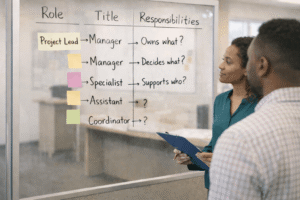
Growth rarely feels like a problem—until it starts creating friction.
New clients come in. Teams expand. Output increases. From the outside, everything looks positive. Internally, however, many companies begin to sense that the way they operate no longer matches their size.
The operational maturity model helps explain why this happens. It shows how businesses evolve through different stages of structure, process, and ownership—and why growth eventually outpaces informal ways of working.
This article explores how operational maturity develops, the signals that indicate a company has outgrown its current operating model, and what typically comes next.
What Is an Operational Maturity Model?
An operational maturity model describes how a company’s internal structure evolves as it grows. Early-stage organizations rely heavily on individuals, informal processes, and direct communication. More mature organizations depend on systems, defined roles, and repeatable workflows.
Neither approach is inherently better. Problems arise when a company remains structurally immature while operational complexity continues to increase.
This mismatch is what creates growing pains—not growth itself.
Stage 1: Founder-Led and Informal Operations
In the earliest stage, operations are fluid and highly personal.
Decisions are fast. Knowledge lives in people’s heads. Coordination happens through conversations rather than systems. This stage allows companies to move quickly, but it also creates invisible dependency.
Many of the risks described in Key Person Risk: Why Relying on One Employee Puts Your Business at Risk originate here.
Stage 2: Growth Begins to Expose Structural Gaps
As companies grow, volume increases faster than structure.
More clients mean more coordination. More team members mean more communication paths. Temporary workarounds become permanent solutions simply because “they work.”
This is often when teams begin to experience the issues described in Remote Team Management: What Breaks When Your Team Starts Scaling.
Stage 3: Operational Bottlenecks Become Visible
At this stage, friction becomes harder to ignore.
Leaders spend more time answering questions, unblocking tasks, and coordinating work that once flowed naturally. Back-office responsibilities expand quietly, pulling attention away from strategy.
This shift mirrors what’s outlined in Back Office Operations: The Hidden Bottleneck in Growing Companies.
Stage 4: Structure Becomes a Strategic Decision
Companies that continue growing successfully reach a point where structure becomes intentional.
Instead of adding people reactively, they design roles around predictable workflows. Operational support is introduced to reduce dependency on senior talent and ensure continuity.
This is where roles like:
- Office and Operations Managers
move from “nice to have” to essential.
How Operational Maturity Supports International Growth
Operational maturity becomes even more critical when companies expand across borders.
Distributed teams, time zone overlap, and compliance introduce complexity that informal systems can’t absorb. This is why companies scaling internationally often shift toward structured models rather than ad-hoc hiring.
Many follow a gradual path similar to what’s described in Scale Your Team in Argentina: From First Hire to Full Department.
The Role of a Second Office in Operational Maturity
At higher levels of maturity, companies stop thinking in terms of isolated hires. They think in terms of operating models.
The Second Office model supports this transition by providing:
- Dedicated operational roles
- Clear ownership and coverage
- Long-term team integration
Rather than patching gaps, it reinforces structure as the organization grows.
Operational Maturity Isn’t About Slowing Down
Maturing operations doesn’t mean adding bureaucracy or losing agility. It means designing systems that allow growth without constant intervention.
Companies that align structure with size move faster—not slower—because decisions, communication, and execution no longer depend on a few individuals.
If your company is growing and your current operating model no longer fits, OfficeTwo helps you build operational structure through its Second Office model—so growth stays sustainable.
FAQ
What is an operational maturity model?
It’s a framework that explains how business operations evolve as companies grow, moving from informal processes to structured systems.
Why does growth create operational friction?
Because complexity increases faster than structure, exposing gaps in ownership, processes, and coordination.
When should a company rethink its operating model?
When leaders spend more time unblocking work than planning, or when growth depends too heavily on specific individuals.
How does operational maturity support scaling?
It ensures workflows, roles, and decision-making evolve alongside growth, reducing risk and dependency.
Can operational maturity improve remote or international teams?
Yes. Structured operations are essential for aligning distributed teams, especially across time zones and countries.