Hybrid and remote work are increasingly common in construction—at least for the office side of the business. While crews remain in the field, many companies now run key functions through remote construction teams, covering project coordination, administrative support, estimating, accounting, and customer communication.
For leadership, the goal is straightforward: keep projects moving, protect margins, and improve responsiveness—without adding unnecessary overhead.
But as teams split between in-office and remote, a pattern often emerges: work still gets done, yet it takes more effort than it should. Small delays stack up, accountability becomes less clear, and managers spend more time coordinating than leading.
That pattern is what many companies experience as operational friction—and it’s not a remote-work problem. It’s usually a team design problem.
This guide breaks down where friction shows up in hybrid and remote construction teams, why it’s so common in construction operations, and how structured models help prevent it—while preserving the flexibility companies want.
Why Construction Operations Are Especially Challenging for Remote Teams
Construction operations depend on tight coordination across moving parts: timelines, subcontractors, materials, inspections, change orders, and client communication. Unlike industries where work can be isolated into long, uninterrupted blocks, construction requires constant synchronization between roles.
That’s why hybrid and remote setups tend to amplify issues that already exist:
- Handoffs matter more. Estimating feeds project planning, which feeds production, which feeds billing and customer updates.
- Decisions are time-sensitive. Waiting for approvals can mean idle crews, missed deliveries, or scheduling conflicts.
- Accountability must be crisp. If “someone” owns a task, no one owns it.
- Tools don’t solve process gaps. Software can track tasks, but it can’t define ownership or prevent duplicated work.
When companies expand remote support without defining how work flows, friction appears—not because work is remote, but because the operation lacks a system that scales.
Where Operational Friction Shows Up in Hybrid and Remote Construction Teams
Operational friction is rarely dramatic. It’s more often a collection of small issues that repeat weekly—each one minor on its own, but costly in aggregate.
Ambiguous ownership between office and remote staff
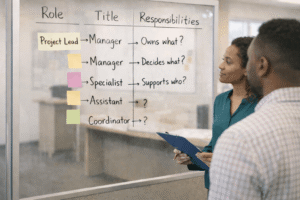
A common scenario: tasks bounce between in-office and remote team members because responsibilities aren’t clearly divided. Someone starts a task, someone else continues it, and a manager ends up resolving the last 10% through meetings and messages.
This is especially common when remote construction project management support is added informally, without documenting what the remote team owns end-to-end.
Approval delays and “waiting time” that doesn’t show up on reports
In hybrid teams, approvals often happen opportunistically—whoever is around signs off. When time zones, meeting schedules, or field availability don’t align, work pauses in ways that are hard to track.
The result is a subtle slowdown: fewer tasks completed per week, more status checks, and more “quick calls” to unblock work.
Duplicated work and inconsistent updates
Two people update two different documents. A change order is logged in one place but not another. A client update is drafted twice. These issues are common when teams lack a single workflow and system of record.
Manager-as-bridge overload
When structure is missing, managers become the bridge between office and remote teams—explaining context, relaying decisions, and connecting dots. This creates dependency and makes growth harder.
If scaling requires more manager time per project, the model isn’t scalable.
The Real Risk Isn’t Remote Work — It’s Unstructured Team Design
When hybrid or remote work creates friction, the immediate reaction is often to blame location: “We need more people in the office.” But in many cases, proximity is not the root cause.
The deeper issue is that hybrid and remote teams fail to perform when:
- Roles are defined by “helping out” instead of ownership
- Workflows live in people’s heads instead of documentation
- Communication replaces process
- Accountability is shared rather than assigned
A structured model prevents friction by turning coordination into a system. Instead of relying on constant alignment meetings, the team operates through clear ownership, repeatable workflows, and predictable handoffs.
That is what separates a remote team that scales from one that merely “survives.”
What High-Performing Hybrid and Remote Construction Teams Do Differently
The most reliable teams don’t treat remote work as a perk or a workaround. They treat it as an operating model that needs design.
Here are the practices that consistently reduce friction:
Define ownership at the task level
Instead of “the team handles admin,” define who owns which outputs:
- Who owns client updates?
- Who owns change order intake?
- Who owns document control and versioning?
- Who owns subcontractor follow-ups?
When ownership is clear, work moves without escalation.
Document workflows for recurring processes
Construction has repeatable work even when projects vary: intake processes, scheduling updates, RFI tracking, invoice workflows, reporting, and customer communication. Documenting these workflows reduces confusion and makes onboarding faster.
Design overlap hours intentionally
A remote model works best when overlap isn’t accidental. High-performing teams define overlap windows for approvals, coordination, and real-time decisions—so the rest of the day can remain focused and asynchronous.
Use centralized reporting (and agree on one source of truth)
Tools only work when teams agree how they’re used. A single system of record, clear update rules, and consistent reporting rhythms reduce duplication and prevent information drift.
Hybrid vs Remote in Construction: What to Consider Before You Choose
Many companies frame this as a binary choice. In reality, hybrid and remote work models can both be effective in construction environments, as long as the structure behind them is intentional and well defined. As we explain in our overview of hybrid vs remote work, the key difference isn’t where people sit—it’s how work is organized.
Hybrid may be a fit when:
- the office plays a central coordination role for multiple departments
- on-site meetings are frequent and operationally necessary
- leadership prefers a physical hub for cross-functional alignment
Remote may be a fit when:
- work can be driven through well-defined workflows
- roles have clear deliverables and handoffs
- the company needs scalable support without adding local overhead
The most important point is that structure matters more than location.
Why Flexible Staffing Reduces Friction During Growth and Seasonal Swings
Construction operations rarely grow in a straight line. Some months require more coordination, more administrative capacity, and more client communication, while other periods call for a leaner operational footprint. That’s why many teams turn to flexible staffing models that can adapt as workload changes—without forcing constant internal restructuring. As outlined in our guide to remote staffing flexibility, the goal is to align capacity with demand, not to stretch teams beyond their limits.
When staffing is rigid, companies often respond by overloading existing team members—creating exactly the burnout and slowdown where friction thrives.
Flexible models help because they allow companies to:
- Add capacity for support roles without disrupting existing workflows
- Protect core project managers from administrative overload
- Scale up for new projects quickly, then stabilize once delivery is smooth
- Maintain consistent processes even as volume changes
How OfficeTwo Helps Construction Companies Reduce Operational Friction
Reducing operational friction isn’t about hiring “more people” or forcing everyone back into an office. It’s about building a team model that has:
- Clear role definitions and ownership
- Structured onboarding tied to real workflows
- Ongoing management support and accountability
- Stable teams that improve over time—not a revolving door
OfficeTwo’s Second Office Model is designed to help construction companies build remote teams that operate like an extension of the business—with structure, consistency, and long-term support. Instead of patchwork remote roles, companies get a coordinated operating system built for scalability.
Final Thoughts
Operational friction in hybrid and remote construction teams is rarely caused by location alone. It’s typically the result of unstructured team design—unclear ownership, inconsistent workflows, approval delays, and over-reliance on managers as the bridge.
The companies that scale successfully don’t obsess over where people sit. They focus on building an operation where accountability is clear, workflows are repeatable, and coordination is designed—not improvised.
When structure comes first, hybrid and remote models can become a competitive advantage rather than a source of drag.
Want to reduce operational friction and scale your construction operations with a structured remote team?
Talk to OfficeTwo about building a Second Office Model that improves coordination, protects your core team, and supports growth.
Contact OfficeTwo to build your remote construction team.
FAQ
How do construction companies manage remote teams without losing control?
Construction companies that manage remote teams successfully rely on structure rather than constant supervision. This includes clearly defined responsibilities, documented workflows for recurring tasks, and consistent reporting systems. When expectations are explicit and ownership is clear, managers can focus on oversight and decision-making instead of daily coordination.
What types of construction work are best suited for remote teams?
Remote teams are typically most effective in roles that involve coordination, documentation, and communication rather than physical execution. Common examples include project coordination, administrative support, estimating, accounting, scheduling updates, and customer communication. These roles benefit from structured workflows and predictable handoffs rather than physical presence.
Does remote work slow down construction projects?
Remote work does not inherently slow down construction projects. Delays usually occur when teams lack defined processes, clear approval paths, or sufficient overlap time for coordination. Well-structured remote teams often reduce delays by improving documentation, response consistency, and workload distribution.
How important are time zones for remote construction teams?
Time zone alignment plays an important role, particularly for roles that require frequent approvals or real-time coordination. Many construction teams succeed by setting defined overlap hours each day, ensuring decisions can be made quickly while still allowing most work to happen asynchronously.
What is the biggest mistake companies make when building remote construction teams?
The most common mistake is adding remote staff without redesigning workflows or clarifying ownership. When remote roles are treated as informal support rather than fully integrated positions, friction increases. Successful teams design remote roles intentionally, with clear accountability and long-term integration into the operation.