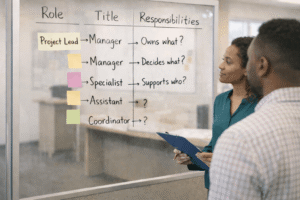
When construction companies grow, the progress is usually visible in the field: more active projects, larger crews, and a fuller pipeline. What’s less visible—but just as important—is the operational structure forming behind the scenes.
Companies that scale successfully don’t rely solely on experience or hustle. They build systems that support coordination, communication, and decision-making as complexity increases. These systems are rarely created all at once. They evolve through specific roles that bring clarity and stability to day-to-day operations.
This article looks at how construction companies build scalable operations, and how key roles quietly support growth long before problems appear.
Growth in Construction Is Supported by Structure, Not Just Crews
Early-stage construction businesses often operate through direct involvement. Owners and senior managers oversee projects closely, handle estimates, and stay in constant contact with clients.
As volume increases, this hands-on approach becomes harder to sustain. Companies that continue scaling successfully do so by adding structure—not bureaucracy, but clear ownership across critical functions.
This shift allows leadership to focus on strategy while daily operations remain predictable and controlled.
Project Coordination as the Backbone of Daily Operations
One of the first areas that growing construction companies formalize is project coordination.
As schedules, crews, materials, and subcontractors multiply, coordination becomes essential for keeping projects aligned. High-growth companies treat coordination as a dedicated operational function rather than a task shared informally across roles.
This is where a Construction Project Coordinator plays a central role—ensuring that timelines, communication, and follow-ups stay consistent as workload increases..
Estimating as a Strategic Function, Not a Last-Minute Task
Scalable construction companies recognize that estimating is more than bid preparation—it’s a foundation for profitability and planning.
A well-defined construction estimating process allows teams to:
- Forecast workload accurately
- Price projects consistently
- Protect margins as volume grows
As growth accelerates, many companies assign dedicated ownership to this function, elevating the role of the Estimator in Construction from support to strategic contributor.
Customer Service as a Pillar of Professional Operations
As construction businesses expand, client communication naturally becomes more complex. Updates, scheduling changes, approvals, and issue resolution require structure to remain consistent.
Companies that scale well treat customer communication as an operational pillar. A dedicated customer service function helps ensure that clients receive timely, accurate information while project teams stay focused on execution.
This is where roles like CSR in Construction support both client satisfaction and internal efficiency.
Back-Office Operations That Support Predictable Growth
Behind every well-run construction company is a back-office operation that keeps financial and administrative processes aligned with project activity.
As scale increases, companies rely on structured support for:
- Invoicing and payments
- Cost tracking and reporting
- Documentation and compliance
Roles such as Construction Bookkeepers and Construction Office Managers help transform administrative work into a stable operational foundation, rather than a constant distraction for leadership.
Using Data to Improve Construction Operations Over Time
Growing construction companies generate valuable operational data—from estimating accuracy to project timelines and client interactions.
When this information is actively analyzed, it becomes a tool for continuous improvement. Construction data analysis helps leadership identify patterns, refine processes, and make informed decisions as operations scale.
How OfficeTwo Supports Scalable Construction Operations
OfficeTwo works with construction companies that want to build strong operational foundations without overextending internal teams.
By supporting roles across coordination, estimating, customer service, and back-office functions, OfficeTwo helps companies design operations that scale naturally with growth—through its Second Office model.
Scaling Construction Operations with Intention
Construction companies that scale sustainably don’t wait for operational stress to appear. They build structure incrementally, adding the right roles at the right time.
By investing early in coordination, estimating, customer service, and operational support, growth becomes more predictable—and leadership gains the freedom to focus on what comes next.
Looking to build construction operations that scale with confidence?
Talk to OfficeTwo about creating a Second Office designed to support long-term growth.
FAQ
What does scalable construction operations mean?
Scalable construction operations refer to systems and roles that allow a company to grow project volume without losing control, efficiency, or profitability.
Which roles support construction company growth?
Roles such as project coordinators, estimators, customer service representatives, bookkeepers, and office managers support growth by adding structure and clarity.
When should construction companies formalize operations?
Many companies begin formalizing operations once project volume increases and leadership can no longer oversee every detail directly.
Why is estimating important for scalable construction operations?
Estimating impacts pricing, workload planning, and profitability, making it a strategic function as companies grow.
How does customer service fit into construction operations?
Customer service ensures consistent communication with clients, helping projects run smoothly and protecting long-term relationships.