The construction industry continues to grow, yet many companies struggle to turn demand into sustainable, profitable scale. While external pressures like labor shortages, safety regulations, and material costs often dominate industry conversations, some of the most damaging challenges happen quietly inside construction businesses themselves.
Operational bottlenecks, management inefficiencies, and poorly structured workflows slow teams down, increase costs, and create unnecessary stress for owners and leadership teams. These challenges don’t always stop companies from winning work—but they do prevent them from scaling effectively.
This article explores the most common construction industry challenges from an operational and management perspective, focusing on what breaks as companies grow and why fixing these issues requires more than simply hiring more people.
Why Construction Companies Struggle to Scale
Growth in construction is rarely predictable. Winning more projects doesn’t just increase revenue—it multiplies complexity. Processes that once worked for a small team often fail when project volume increases, timelines overlap, and more stakeholders become involved.
As companies scale, common warning signs begin to appear:
- Projects take longer to complete despite larger teams
- Internal communication becomes reactive instead of structured
- Owners are pulled deeper into daily decisions
- Administrative tasks grow faster than revenue
These symptoms aren’t caused by a lack of effort or talent. They’re the result of operations that were never designed to support growth at scale.
Construction Management Challenges That Impact Daily Operations
Fragmented coordination across teams
In many construction companies, coordination between estimating, project management, field crews, and administration relies heavily on informal communication. Information is shared through emails, calls, and spreadsheets—often without a single source of truth.
This fragmentation leads to:
- Missed handoffs between estimating and execution
- Inconsistent project documentation
- Delays caused by misaligned priorities
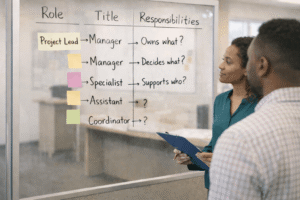
As teams grow, these coordination gaps become harder to manage—especially without clearly defined ownership across roles such as Project Coordinators who help keep construction projects on track.
Owner dependency and decision bottlenecks
As businesses grow, owners often remain central to approvals, scheduling decisions, and issue resolution. While this hands-on approach may have driven early success, it becomes a bottleneck as volume increases.
When key decisions can’t move forward without owner input:
- Teams slow down
- Leadership becomes reactive
- Growth feels chaotic rather than controlled
This challenge is one of the most common—and least addressed—construction management issues.
Limited visibility into operations and performance
Without standardized workflows and reporting, leadership teams struggle to understand what’s really happening across projects. Basic questions become difficult to answer:
- Which projects are at risk?
- Where are margins being lost?
- Which processes consume the most time?
Lack of visibility prevents proactive decision-making and forces teams into constant firefighting.
Operational Bottlenecks Inside Growing Construction Companies
Estimating delays and pre-construction overload
As inbound demand increases, estimating teams are often the first to feel the strain. Quotes take longer to deliver, follow-ups are delayed, and opportunities are lost before projects even begin.
This bottleneck doesn’t just affect sales—it disrupts scheduling, cash flow, and capacity planning. As companies scale, understanding what a construction estimator does and why this role becomes essential becomes critical to avoiding downstream issues.
Back-office inefficiencies
Administrative work scales faster than most construction leaders anticipate. Invoicing, compliance documentation, scheduling updates, client communication, and reporting quickly pile up—often handled by the same small group of people.
These inefficiencies:
- Pull focus away from higher-value work
- Increase error rates
- Create burnout in critical roles
Despite being less visible than field operations, back-office inefficiencies are among the most damaging construction challenges.
Inconsistent processes across projects
When workflows vary from project to project, teams rely on tribal knowledge rather than repeatable systems. This inconsistency increases onboarding time, creates confusion, and makes performance dependent on specific individuals rather than clear processes.
Over time, this makes scaling unpredictable and risky.
How Construction Inefficiencies Affect Growth and Margins
Operational inefficiencies rarely appear as a single failure. Instead, they accumulate over time, showing up as:
- Small delays that compound across multiple projects
- Margin erosion caused by rework and missed details
- Reduced capacity to take on new work
- Increased stress on owners and managers
As inefficiencies grow, leaders often become hesitant to pursue new opportunities—not because demand isn’t there, but because operations feel fragile.
From Process Optimization to Operational Structure
Many construction companies attempt to solve these challenges by:
- Adding more software tools
- Hiring additional in-house staff
- Outsourcing isolated tasks
While these approaches can help temporarily, they often fail to address the root issue: the absence of a cohesive operational structure designed to support scale.
True optimization requires:
- Clearly defined operational roles
- Standardized workflows across projects
- Teams that can absorb growth without increasing internal chaos
Addressing Construction Challenges Without Adding Complexity
The most resilient construction companies rethink how their operations are built. Instead of expanding overhead internally, they focus on:
- Separating execution from oversight
- Standardizing repeatable tasks
- Building dedicated operational support teams
This approach reduces owner dependency, improves visibility, and creates a stable foundation for growth—without sacrificing control or quality.
Learn how OfficeTwo supports construction operations behind the scenes.
Building Scalable Operations in a Changing Construction Industry
The construction industry will continue to evolve, but operational challenges will remain a defining factor in which companies succeed long term. Companies that address bottlenecks early, invest in structure, and prioritize operational clarity are better positioned to grow with confidence.
For construction and roofing businesses, the challenge isn’t finding work—it’s building operations that can support growth without breaking under pressure.
Ready to reduce operational bottlenecks and scale with confidence?
👉 Talk to OfficeTwo about building an operational structure that supports growth.
FAQ
Are construction industry challenges the same for small and large companies?
No. While many challenges are shared, smaller and midsize construction companies tend to feel operational bottlenecks more quickly because they rely on fewer people and less formalized processes.
Why do operational problems often appear after a company starts growing?
Growth increases complexity. As project volume rises, informal workflows and ad-hoc coordination stop working, exposing gaps that weren’t visible at smaller scales.
How can construction companies identify their main operational bottlenecks?
The most effective way is to analyze where delays, rework, or repeated errors occur—especially in estimating, coordination, administration, and reporting—rather than focusing only on field performance.
Do tools and software alone solve construction inefficiencies?
Not usually. Tools can support efficiency, but without clear roles and standardized workflows, software often adds complexity instead of reducing it.
When should a construction company rethink its operational structure?
If growth depends heavily on owner involvement, projects slow down internally, or teams feel constantly overloaded, it’s a strong signal that the operational structure needs to evolve.