When people think about construction work, they usually picture what happens on the job site. Crews, schedules, materials, and execution are the most visible parts of the business.
In well-run construction companies, however, a significant part of the work happens away from the field. Coordination, communication, financial oversight, reporting, and leadership support all take place beyond the job site—and are essential to keeping daily operations consistent.
This structure isn’t about fixing problems or reacting to growth. It’s simply how established construction companies organize responsibilities so projects, teams, and clients remain aligned day to day.
The Construction Company Organizational Structure Beyond the Field
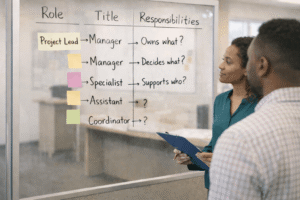
A construction company’s organizational structure typically separates field execution from coordination and oversight. While crews focus on delivering work on site, other teams manage the information and processes that support execution.
Beyond the job site, responsibilities usually include:
- Internal coordination and scheduling
- Administrative and financial oversight
- Client communication and continuity
- Leadership support and reporting
- Performance tracking and data analysis
This separation allows each function to operate with clarity. Field teams concentrate on execution, while support roles ensure consistency and follow-through across the organization.
Office Management as the Center of Daily Coordination
Office management often acts as the central point where information, tasks, and priorities come together.
Construction Office Managers oversee documentation, internal communication, task tracking, and operational follow-ups. Their role helps ensure that updates from the field are captured, shared, and acted on without disrupting execution.
Rather than solving issues as they arise, office management creates continuity in how work is organized beyond the job site.
Executive Support and Leadership Focus
In professional construction organizations, leadership roles are designed to focus on decisions, priorities, and direction—not daily coordination.
Construction Executive Assistants support this structure by managing schedules, communication flow, and administrative responsibilities. This allows leadership to stay informed and available without becoming the center of every operational detail.
Executive support doesn’t replace leadership involvement—it helps structure it.
Account Management and Client Continuity
Client relationships in construction often span multiple projects and long timelines. Maintaining consistency across those interactions requires clear ownership.
Construction Account Managers serve as a stable point of contact between clients and internal teams. They help ensure that communication, updates, and expectations remain aligned throughout ongoing work.
This role supports continuity without pulling project teams away from execution.
Production Management Beyond the Job Site
Production management extends beyond what happens in the field. While crews execute work on site, production oversight ensures alignment across schedules, resources, and deliverables.
Construction Production Managers focus on coordinating plans across projects and teams. Their work helps maintain predictability and balance across the broader operation, not just individual jobs.
Financial and Administrative Structure
Financial clarity is part of how construction companies stay organized beyond the job site.
Construction Bookkeepers handle invoicing, cost tracking, payroll coordination, and financial reporting. Their role ensures that project activity is accurately reflected in financial systems and available for decision-making.
This structure allows leadership and project teams to work with reliable financial information rather than assumptions.
Data and Insight as Part of Daily Operations
Modern construction companies generate constant operational data—from schedules and budgets to timelines and performance metrics.
Construction Data Analysts help transform that information into insight. Their role supports reporting, forecasting, and analysis that inform planning and internal coordination.
Data becomes part of daily operations, not a separate initiative.
How These Roles Work Together
These roles don’t operate in isolation. Office management, executive support, account management, production oversight, finance, and data analysis form a connected structure that supports daily work beyond the job site.
This layered organization is a defining characteristic of well-run construction companies. It allows field teams to focus on execution while the rest of the organization maintains alignment, continuity, and clarity.
For a broader conceptual view of how structure evolves, see The Operational Maturity Model: When Growth Outpaces Structure.
Where the Second Office Model Fits
This organizational structure isn’t about outsourcing tasks. It’s about organizing responsibilities clearly—whether roles are in-house or part of an integrated team.
The Second Office model supports this approach by grouping operational, administrative, and management roles into a cohesive extension of the business, designed to work alongside internal teams.
Looking to organize work beyond the job site with a more structured support team?
OfficeTwo helps construction companies build integrated Second Office teams aligned with how established organizations operate.
FAQ
What does “beyond the job site” mean in construction?
It refers to the coordination, management, and support work that happens outside the field, including office operations, finance, client communication, reporting, and leadership support.
Why is organizational structure important in construction?
Because it creates clarity around responsibilities, supports consistent workflows, and helps teams stay aligned across multiple projects and stakeholders.
Are support roles separate from field operations?
No. Support roles complement field operations by handling coordination, documentation, communication, and oversight that crews shouldn’t need to manage.
Which roles are typically part of construction support teams?
Common roles include office managers, executive assistants, account managers, production managers, bookkeepers, and data analysts.
Can these roles be part of a remote or nearshore team?
Yes. Many construction companies integrate these roles into remote or nearshore teams when responsibilities and workflows are clearly defined.